
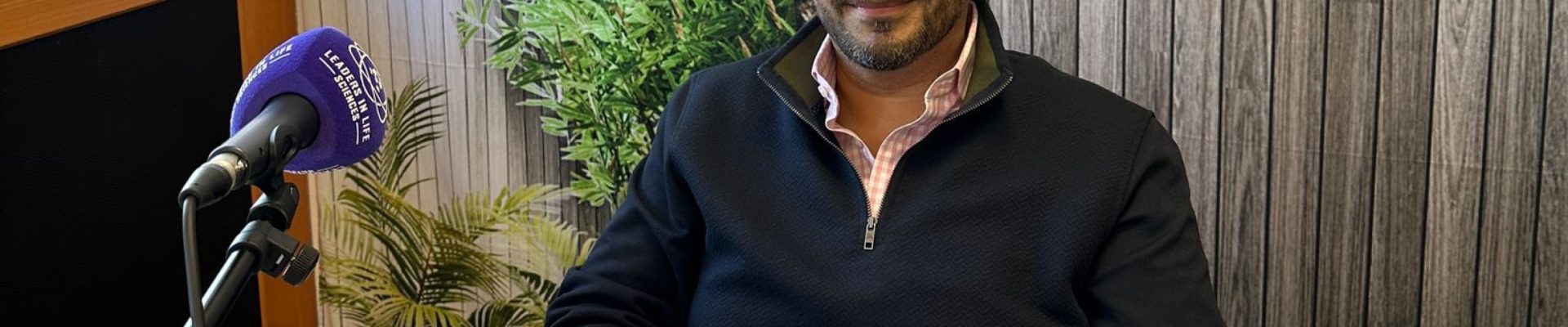
Dit is Leaders in Life Sciences, een podcast waarin we op zoek gaan naar het verhaal achter de mens. We praten met leiders van nu en later over wat hun drijft, hun carrière en privéleven. Want door naar elkaar te luisteren komen we als individu en als sector verder. We willen onze partners hartelijk bedanken voor hun steun, dat zijn Pivot Park, Pedersen & Partners en Johnson & Johnson Innovative Medicine. Te gast in deze aflevering, Anish Mehta. Uw host is Henk Jan Out.
Henk Jan Out
Welcome everybody, thanks for listening. Today’s guest was born in Chicago, trained as a biomedical engineer and he joined the pharmaceutical industry in 1995. He had various positions in sales, marketing and business development in companies like Ospyra, Baxter, Actavis and Allergen. He moved to Europe and became CEO of Theramax, a London-based women’s health company, and subsequently joined the Dutch company Synthon in 2021 as its CEO. He is still based in London and is commuting to Nijmegen, where Synthon’s headquarters is located, and to the many affiliations of this generic company. His Dutch is a bit rusty, so we agreed to do this podcast in English instead of Dutch. So welcome Anish and thanks for coming to Oss here in Pivot Park.
Anish Mehta
Thank you, thanks for having me. It’s a pleasure to be here.
Henk Jan Out
Now, most of your professional career has been in the generics industry. So tell me, how did you get there? You were trained as a biomedical engineer.
Anish Mehta
That’s right. Well, you know, I was fortunate enough to be kind of part of a pharmaceutical family. You know, I grew up in Chicago and my father was a chemical engineer and my father worked in pharmaceuticals. So I was lucky enough that during my summer breaks that I had the opportunity to work in a pharmaceutical company called Abbott Labs. And that was really my kind of first exposure to the industry.
Henk Jan Out
What sort of work did you do there?
Anish Mehta
Well, I did some painting, I did some moving things around in a warehouse.
Henk Jan Out
Very generic things basically.
Anish Mehta
Very generic things. And, you know, it was a great program where they had kids of employees come in, and they wanted to kind of give them an introduction to a very important industry. And I have to say, it was kind of fun. Lots of my friends were there, and I said, “Huh, these companies are kind of cool.” I never thought about it when my dad was there, but then actually going in there and doing a bit of work—it’s kind of a nice thing to do. And that’s really how I got started. And one summer internship led to another summer internship. And then, as I was studying engineering, I really was sort of thinking about, “Do I want to be a doctor, or do I want to work in the industry?” And I knew I loved the whole sciences and mathematics, but I wasn’t sure what I wanted to do. And some of those experiences kind of led me towards getting my first job at Abbott in the pharma industry.
Henk Jan Out
As an engineer?
Anish Mehta
As an engineer. So that was a bit different than doing painting and moving boxes around.
Henk Jan Out
Absolutely, yeah.
Anish Mehta
As a young engineer I got to work in different factories, and kind of seeing how the products were made, working on equipment, and working on process chemistry. And I spent a number of years doing that. And, you know, I came out of that with two very strong conclusions. One was that I really love the industry, and I love the purpose-driven mindset and the impact that it has on people. And number two, I learned I was a terrible engineer and that I needed to find something else to do in the industry.
Henk Jan Out
And what was that?
Anish Mehta
Well, I wanted to kind of move to the business side. I saw some colleagues that were doing sales, marketing, and business development. You know, the whole pharma healthcare industry is really about collaboration. No single company can do everything on their own. And I saw these people who were working with other companies, with research institutions, with universities. I’m like, “That’s actually pretty interesting.” Like, I’m a people person. I love, I love, you know, engaging with people. I’m an extrovert. So I decided to go and do my MBA. So I left my job and went to the University of Pennsylvania, the Wharton School, to do my MBA in strategic management and finance. And it was, you know, very different from engineering. And it really kind of rounded out my, let’s say, academic experiences. And from there, I said, “I want to stay in healthcare, but I need to find a way to transition.” And that’s when I ended up joining McKinsey, which is the management consulting firm.
Henk Jan Out
Right. So, did your engineering background help you somehow in your activities at McKinsey, or was it completely useless at the end?
Anish Mehta
Yeah, it’s a good question. So engineering, at least at US universities, has two very important parts. One of them is that it teaches you how to structure problems. It’s very much an analytical approach to thinking about something complex, make it simple, and then using data to answer the question. And then the second one is obviously the more technical aspects, like thermodynamics and all those kinds of things. And it’s the first one that’s really, frankly, relevant to almost everything. Especially in consulting, where you’re working with clients, tackling different kinds of problems that you’re trying to solve, and ultimately, it all kind of comes down to the same thing. How do you take something that’s big, complex, and multifaceted and break it down into what really matters? And I think that’s really what my education helped me do.
Henk Jan Out
I can also imagine as a biomedical engineer that will help you in also in the generics business where lots of it is about improving efficiency of manufacturing and then that knowledge might be quite helpful.
Anish Mehta
Yeah, exactly. And again, to do biomedical engineering, I had to study biology, chemistry, and physics, so really understanding the basic sciences. And all of that, obviously, is the foundation of pharmaceuticals and generics. So that fundamental part, and then, of course, the engineering part—looking at efficiencies and scaling things up. And again, how do you make things at the right quality more efficient? And that’s really where the engineering part of the brain kicks in.
Henk Jan Out
Right. So you joined McKinsey. It’s quite interesting. Many of our guests here in the podcast started at McKinsey and then found themselves back at a startup or another pharmaceutical company. So the same thing happened with you, right?
Anish Mehta
Yeah, exactly. Exactly. It’s one of those places where it’s a fantastic learning ground. And the whole company is set up to attract and hire ambitious, smart people with either MBAs or technical backgrounds, and they just continue the learning journey. So while you’re contributing to helping clients improve their businesses or solve difficult problems, you’re learning at the same time and advancing that whole problem-solving skill set—how to do presentations. I mean, this is one of the things that people really underestimate. In university, no one really teaches you how to do a presentation. You’re studying numbers, sciences, or whatever, and doing tests. But in the real world, it’s all about how you convey an idea, right? How do you get other people to understand? And McKinsey is fantastic at that.
So I did that for a number of years, and I was focused mostly on healthcare and life sciences.
Henk Jan Out
One of the fantastic things there, I think, is probably that you also can look at the kitchen of many of the different industries, see how they deal with the different issues and how they solve it. So you get a very broad background about giving the final advice to your clients.
Anish Mehta
That’s right. And it’s both from the functional point of view and the industry point of view. So you could be working in the automotive industry, the airline industry, or the pharmaceutical industry, but you could also be working on supply chain, sales and marketing, or a new product launch. I was lucky enough to have a number of those experiences where I got to see, you know, the kitchen, as you call it, for a bunch of companies. And then you, yeah, you start to really figure out what good looks like.
And again, I think a career is not a series of destinations. I mean, a career is kind of a meandering journey. And every time you have a job, the idea is to contribute, you know, be productive, and learn. And that’s kind of what I’ve always… That’s my mantra. Just like, if I’m not learning anymore, it might be time for me to do something different.
Henk Jan Out
So you took all that learning experience to your first real pharmaceutical company, and that was which company again?
Anish Mehta
Yeah, so actually, I went back to Abbott. After I did McKinsey, I went back to Abbott. I was actually recruited back to Abbott by somebody I used to work for, and in this situation, it was in a sales and marketing job. I think that kind of started the second part of my career, which was really back in the healthcare industry, but now on the side that I wanted to be on, which was sales and marketing and business development. I was lucky enough to have a series of roles where I was doing actual sales, I was doing marketing, I was doing strategy, and I was engaging with patients, engaging with physicians, and looking at new products. And again, all of this confirmed my belief, which was, this is my passion. And I said, “Okay, now this is the industry. I love the industry, I love the people in the industry, and I love the impact.” And that’s kind of how that second part of my career started to evolve.
Henk Jan Out
And particularly business development, you’ve done a lot, right?
Anish Mehta
I have.
Henk Jan Out
Because you’ve made some very big deals in your professional life, I believe.
Anish Mehta
I have, I have. Some may call me a deal junkie. I would say I’m not a deal junkie, but I certainly enjoy doing deals. And I think it’s back to what I said earlier; this industry really is one of collaboration. I mean, it is not possible, given the complexity of the science, the cost of bringing products to market, and the cost of marketing them. It’s not possible to do it on your own. So, you know, how you collaborate and how you do deals is just super important. I’ve always had this sort of win-win philosophy. It’s not about, you know, how do I get the best deal possible? It’s about how you create an environment where everyone feels like they get something out of it. Over the course of my career, I started doing smaller licensing deals where you pay some money to bring a product in. I out-licensed some deals, sold assets, bought assets, and ultimately ended up doing a lot of buying and selling of companies—some from families, some public companies. And so I’ve been lucky in my career to have kind of the full arsenal of loads of different types of deals. And each one is different. You know, size doesn’t mean it’s harder or less hard. It’s really the environment, who you’re buying it from, that determines the complexity.
Henk Jan Out
And this also became part of the identity of the pharmaceutical industry, I think. Because in the past, every big company did their own research, their own development, they did everything on their own. But that idea shifted into, “Let’s do things together, and if somebody else can do it better, let’s buy that company or try to make a deal.” That whole mindset has shifted, I think.
Anish Mehta
Exactly. And I think you have two sides of this coin. One of them is in generics, and one of them is in the more innovative side of medicine. On the innovative side of medicine, I think the larger companies were getting so big that they realized they needed to find new sources of innovation. And the more they started buying, the more companies were popping up with smart scientists and great ideas, and they were just accelerating the pace of innovation. So more and more deals were happening. And now, you know, it is just such an enormous source of new products and new ideas for the large companies because they want to complement what they can do on their own with these agile, nimble companies. And then you flip to the other side, which is generics. After I finished doing some of these more innovative things, I moved into the generics industry in 2010 and joined a company called Watson Pharmaceuticals. Watson was a US-based generics company that was on the verge of globalizing because the generics industry was really taking off, and the need for high-quality, affordable medicines was just almost unlimited. So companies like Watson that were still scientifically focused and had a real commitment to quality had a huge demand. And that was also fueling our growth aspirations, and we ended up doing a lot of growth through acquisitions. We bought a company in the UK, then we bought a company in Greece, and then we bought another company in Iceland. And one thing led to another, partly to fuel the supply for the demand that was there, and the other thing was around what it takes to be successful in generics, which is scale.
Henk Jan Out
Because I got the impression that those consolidations particularly took place a lot in the generic industry.
Anish Mehta
That’s right. They took place in the generics industry, again, to drive scale and cost of goods. And you just had this kind of market phenomenon where the demand was increasing so much, but at the same time, pressure on pricing was just so high. And that’s actually something that hasn’t changed, right? The pressure to produce products at the lowest possible price is so fierce that you just have to be a scale player.
Henk Jan Out
Why is that? I always wonder—why is so much happening with drugs? I mean, I don’t see the price pressure on many other goods that people use. But somehow, we have this idea that drugs need to be as cheap as possible, and we go to great lengths and make enormous efforts to make that happen, to such an extent that we now have shortages. Why do we think that medicine… Perhaps you can explain what it takes to make a generic, because that’s not so easy, is it?
Anish Mehta
You know, to make a generic, a lot of people think it’s just a straight copy of something that’s on the market, anybody can do it, et cetera, et cetera. But that’s not the reality of it. I mean, at the end of the day, it’s still a pharmaceutical product that goes into the human body or a patient, and it needs to have the intended effect, whether it’s something for the heart, the thyroid, the kidney, or whatever it may be. You want to make sure, and you need to make sure, that the patient getting the product is getting the therapeutic benefit from this medication. So in order to do that, the generic companies have to go through a whole development process where they are working on the science, doing the testing, manufacturing the product under real conditions, and testing the storage and stability conditions. Because when you read the packaging on a medication and it says to store it at a certain temperature, not everyone does. So you have to make sure that if they store it in a warmer or colder temperature, or if they use it longer or shorter, it’s still going to be okay and not cause any harm to the patient. Then you have to do testing to make sure that it actually behaves in the same way that the innovator product behaves. And you do that—it’s called bioequivalence testing—in healthy volunteers to make sure that, again, it’s getting the desired effect. So when you put all that together, each individual drug will still cost millions of euros to develop. And then you have to get it registered. And then you have to make it available. There are regulatory fees, because, of course, the regulatory agencies have to evaluate all the data and make sure that it is what it says. Now, of course, it’s an industry that has a very, very high ethical standard, so we are self-policing in a way that, as an industry, we’re not submitting data or trying to get drugs approved that shouldn’t be. But at the same time, you always need checks and balances. Then there’s the whole manufacturing process—how you ensure the right quality, how you ensure the right consistency—something called GMP, Good Manufacturing Practices, which sets a very, very high standard, as it should. When you put all that stuff together, I think your listeners should feel very comfortable whenever they go to the pharmacy, whether it’s in the Netherlands or in the UK, or wherever it is, whatever generic medication they’re getting has been made under the right conditions, has gone through the right testing, and they should feel very, very comfortable that it will do what it says it does. And it’s taken some years to get to that, right? Because it’s still kind of a new industry still, but I’m very comfortable, having been doing this for now 30 years, that we’re at the right place where we should be. And, you know, we have a real positive effect on patients.
Henk Jan Out
And yet, then we have pills at the pharmacy that are even cheaper than the packaging sometimes. How is that possible?
Anish Mehta
Yeah, that’s the great conundrum of this industry, which is exactly that. I mean, you can go out and buy a cup of Starbucks or a bottle of water, and it might cost more than the actual full manufactured and packaged cost of that pharmaceutical product is. And I think the whole idea of affordable medicines—right, we call it generics, but the idea is that these are affordable medicines—and the number one objective is that it’s helping to drive access for patients. So patients who couldn’t normally afford something that costs a thousand euros a month or a hundred euros a month are now able to get the medication they need because it’s made available through these generic alternatives. The market is so attractive that lots of companies look to do the same thing, and then it just becomes fiercely competitive. In Europe, you normally have the government as the buyer or the payer, and they see the dynamic and say, “Well, if we can use tenders or other purchasing mechanisms to drive the price down, then we’re going to be able to buy more for our constituents,” and so on. So it makes sense conceptually, but at some point, where I think we took our eye off the ball, is that there needs to be a floor. Because on one hand, what I described is a very high cost of development and a very high cost of maintaining the right level of quality. This isn’t a piece of candy or a tissue; it’s something that’s going into your body. But on the other hand, we want it at the cheapest price possible. And as you said, this has caused shortages. And shortages are the worst thing that can happen because patients need the medication.
Henk Jan Out
But before we go into that, how is it possible that the generics industry is still profitable? If you have prices lower than the packaging, how can you ever be profitable?
Anish Mehta
You know, it’s a portfolio game. So what ends up happening is that you have individual products that are not profitable, and then you have other products that are profitable. And this is why the scale concept is so important. You have to have a large portfolio of products, you have to have the scale to manufacture in the most cost-effective way, and you have to have a good procurement organization that allows you to buy components at the most cost-effective prices and then put it all together. Every European country, or frankly, every country around the world, will have a slightly different procurement model. In some markets, you’re able to make a little bit more money faster or for longer. In other markets, you might not make any money from the very beginning. And I think that’s really what the successful generics companies do. Like Synthon, that’s kind of what we do—we really have to look at the big picture and say, we’re still purpose-driven, so we always want to make sure that we bring the first available generic to market because getting patients that access and driving market access is important to us, but we still run a company. So we’ve got to do it in a way that we’re managing different markets and different products.
Henk Jan Out
So we end up now with getting all our active pharmaceutical ingredients from China and India, right? And let’s go a little bit into the shortages. So what do you think is the cause for that shortage and what should we do about it?
Anish Mehta
Yeah. You know, I think the corona pandemic taught us a lot about the importance of global supply chains, about onshore and nearshore manufacturing. So again, terms in the industry, if it’s onshore and nearshore, it’s kind of in continental Europe, let’s say. But I’m sad to say that it taught us a lot for a few minutes because even though we were experiencing these shortages and people weren’t getting everything from toilet paper to pharmaceuticals, there was a lot of talk about this and then nothing really happened. And I think it’s just being very short-sighted because ultimately the APIs that come from India and China are made at vast scales. And the scale of manufacturing is what allows them to have a low cost. And in an environment where you’re dealing with price erosion of 90%, 95%, 99% from the brand price…
Henk Jan Out
From the original price…
Anish Mehta
From the original price when there was still a patent on it, companies in the generics industry have to think about how to deal with that and how to ensure that they can still maintain all the investment required for quality, regulatory, and compliance perspectives while still making a little bit of money.
Henk Jan Out
Yeah, there are still quite a lot of generic companies, aren’t there? So it’s still quite interesting to get into that business.
Anish Mehta
It’s still interesting to get into the business. It’s tougher and tougher because of this whole scale concept and the portfolio concept. Entering the generics industry with a couple of products is very difficult to do, almost impossible. And that’s why you see all this consolidation and you see the ones that are winning are generally the larger companies or the ones that have some kind of a specialized angle.
Henk Jan Out
So how many products go off patent every year that might be of interest of a generics industry?
Anish Mehta
Yeah. So there are about 60 or 70 products that lose exclusivity or patent protection every year. Throughout the US and Europe, you see these products, which include all kinds—some biologics that are now biosimilars, small molecules, and different kinds of products losing exclusivity. And it’s always a race for a lot of generic companies to essentially have a product ready at that loss of exclusivity.
Henk Jan Out
So they start as early as possible, I suppose.
Anish Mehta
They start as early as possible, exactly. And again, I think that’s really what the whole infrastructure is geared up for because the payers, whether it’s the NHS in the UK or other government payers, are really looking for the generic product on the first available day. Because again, it allows them to manage their budgets and ultimately allows more patients to get on the product. So I think the structure of the market is correct, it’s just that we’ve gone a bit overboard on this whole cheaper, cheaper, cheaper thing. And you said it before, whether it’s packaging material, manufacturing, or the product itself, there are very important products for lowering cholesterol—statins, for example—or anti-infectives, or things like omeprazole for reflux. The price that a manufacturing company sells that for could be two euros per pack. Imagine—two euros. Now, of course, there are a lot of people in the value chain, so two euros is not what the patient pays. The patient may pay more if it’s not covered by the government. But just the idea that a company that has to maintain the highest level of standards, quality, and compliance in a highly regulated market needs to produce something for less than two euros and not lose money is kind of a head-scratcher. And if you haven’t walked around factories and you haven’t been in this industry, you kind of think to yourself, should a cup of coffee really cost more than a life-saving therapy? And in the industry, we always say no. So we work very closely with Medicines for Europe, which is the industry association that the generics industry works with to try and influence policy across the EU just to make sure we can focus on sustainability. Quality is paramount—that’s never going to suffer. But what we want is to maintain sustainability. We want more development of local companies and local manufacturing, but you can’t have it both ways, right? You can’t have the cheapest possible price while also wanting to maintain the quality and talent of European manufacturing. And that’s always the push and pull.
Henk Jan Out
So if we want to minimize our dependence on China and India for our APIs, that means that we have to invest in Europe. And that’s going to cost money and that undoubtedly will increase the price of these generics. That’s the only way to deal with it if you want to get rid of countries like China and India, perhaps even the United States in the future.
Anish Mehta
Yeah, that’s right. And I think it’s really about minimizing dependence. It’s not about getting rid of it completely because there are certain things that just need scale. But I think, just for security of supply and for overall health security, many countries are moving in this direction. We do a lot of work in the Middle East, and places like Saudi Arabia are very focused on health security. They’re putting a lot of money to work to say, “In the next 10 or 15 years, we want to reduce our dependence on the East and the West. We want to do development here, we want to do manufacturing here, we want to be able to control it.” And I think finding that balance for Europe is very important as well.
Henk Jan Out
See any movement into the direction?
Anish Mehta
I think it’s pretty slow. It’s pretty slow, to be honest. Now, companies like Synthon have always been committed to manufacturing in Europe. We have two large manufacturing sites, one in the Czech Republic and one in Spain, and honestly, it’s been a real competitive advantage for us. Now, of course, the cost of manufacturing in Europe is higher than in India or China—we’ve already talked about that. But what we try to do is leverage the skill sets we have and the talent we have. So with that portfolio concept, we work on different kinds of products that allow us to have perhaps a slight pricing premium while still being a profitable company. That strategy is not right for everyone, but for a company like ours, whose legacy and heritage is here in the Netherlands—not far from where we’re sitting—I think we’ve really developed this kind of unique European DNA. We can have the agility, we can have the scientific expertise, but we also have that cost mindset, and that’s really what it takes to win.
Henk Jan Out
Well, let’s… Well, you already did it. Let’s go to Synthon. Indeed. So tell me a little bit about Synthon. Let’s start with the history, because it was structured differently some years ago, wasn’t it?
Anish Mehta
Yeah. Well, Synthon was founded about 35 years ago by a scientist, and the whole idea was to start looking into this whole generics industry. Thirty-five years ago, I would say, the market was still forming, and people were just beginning to understand the kind of positive impact generics could have. The founder, an incredibly smart scientist with a very keen understanding of intellectual property, started this company with a few partners. Over the years, with one success after another, he was able to build the company up to what it is today. And today, we’re truly a global pharmaceutical company with over 1,500 employees around the world. We have four manufacturing sites, and we are widely recognized as the development engine for complex generics serving the market.
Henk Jan Out
And because that’s your unique selling point, so to speak. So there’s complex generics. That’s right. Standard generic is complex. So what right. Standard generic is complex. So what’s a complex generic?
Anish Mehta
That’s right. So complex generics, it’s back again to that whole portfolio idea that how do you operate in a market that is fiercely competitive? And I think this is the same in all industries. You have to figure out what you’re good at. And you have to really invest in the right people and the right talent to differentiate yourself. And in our world, in the world of generics, our differentiation comes from these more difficult to make, more difficult to formulate complex generics. And that could be generics that are used for treating cancers, different types of cancers, prostate cancer, breast cancer. It could be drugs to treat multiple sclerosis or different neurological diseases. But it always has to have something in the way the product is developed, the way it’s manufactured, the way it’s tested, or the way it has to be administered that makes it a bit more difficult to do so that others can’t do it. And that’s really what our USP or unique selling point is.
Henk Jan Out
But it must be better. Many other generic companies who have the same approach or not?
Anish Mehta
Well, lots of people try. At the end of the day, these are generics. So there’s always going to be different people who try and do it, right? It’s very different from the whole innovative market where you have walls and walls of barriers protecting your product through patents, through data exclusivity, through different regulatory and legal frameworks. I think in this situation, the assumption is that, look, we’re all driving towards the same thing, which is let’s make the medicine more affordable, more accessible, and let’s treat more patients. And I think as an industry, we are absolutely harmonized in our thinking there. But when it comes to where we play and how we play, this is where Synthon has kind of come out a little bit different. And while others do try and do this whole complex generics thing, I think we do it better than the rest. And there’s a few different reasons. I think one is back to our Dutch heritage of being very scientifically focused and scientifically driven. We’re just better at the science. We can do it more effectively with a higher success rate. I think the other thing is the manufacturing. I mentioned before we have two manufacturing sites here in Europe, and we have two manufacturing sites in Latin America. And a combination of those really allows us to get some cost competitiveness out of Latin America. It allows us to get kind of onshore treatment here in Europe. And we’ve set it up in a way where these factories are kind of interchangeable. So we have built in security, which is really what our customers want, right? They want to know that when there’s more demand or there’s something that happens, Synthon can still provide that medication.
Henk Jan Out
So all of your factories can actually produce all the products that you have in your portfolio?
Anish Mehta
Yeah, so the whole strategy is around dual sourcing and having that security of supply. So that’s something that we really think about to minimize these disruptions. And you mentioned shortages before. I mean, shortages are bad for business, but more importantly, they’re bad for patients. I mean, it’s just, it’s a tragedy when you hear about, you know, antibiotics or other life-saving therapies that are not available because nobody can make money. And these companies are redeploying that capacity or those factories to do something else in order to pay the bills. And that’s a real problem. And again, this is where the industry is trying to work with Medicines for Europe to try and really advocate for different kinds of pricing models and sort of different frameworks to say, look, everyone knows the point of generics is that prices should be more affordable. No question. But you have to have a floor, you know, where it’s still achieving the purpose that it’s intended for, which is making these products available and accessible for patients.
Henk Jan Out
And how many of these complex generics do you have?
Anish Mehta
We have about 75 different products in our portfolio today.
Henk Jan Out
All of your factories can produce those?
Anish Mehta
Well, the factories specialize in different things. So two of the factories make the API or the active pharmaceutical ingredient and two of the factories make the drug product. So they’re interchangeable across each one of those.
Henk Jan Out
And then, so you produce these complex generics and then to whom do you sell them? Who are your customers?
Anish Mehta
Yeah, so we operate a B2B business. So we’re really a business to business company. So if you go to the pharmacy in any of these countries in Europe or the US, you never see Synthon on the box. So our customers are the other generics companies. So you can think of large generics companies like Ateva or Asando. These are the ones that are globally known and that are the absolute leaders in the generics field. Generics, biosimilars, and other products as well. Now, these companies work with us because some of the products they can’t do on their own. And some of the products, they just make a strategic choice to say they’re going to deploy their resources and their capacity towards other types of things, but they’re still interested in making these products available. And that’s created this industry, again, back to the point of collaboration and doing things together in the whole generics industry. It’s created the opportunity for companies like Synthon for us to develop and manufacture the products, but not sell them into the end market. So it’s a really nice model that we’ve kind of flushed out.
Henk Jan Out
So you have a very limited number of customers, I assume.
Anish Mehta
We have a very large number of customers. So again, because of our model and the types of complex generics we have, we have a lot of demand from a lot of customers around the world. So we’re selling to…
Henk Jan Out
And you don’t have many competitors?
Anish Mehta
In some cases, we don’t have many competitors. In some cases, we do. And this is, again, the idea of the harder to make products, the more difficult the requirements are, the more expensive the investments are, they generally will tend to have less competition. And again, that’s then for us, it’s finding the balance between, we get those products into the market through our partners, we make it affordable, but the prices don’t come down to unsustainable levels. And that’s really the right kind of equilibrium that companies like Synthon try and find. Of course, we’re a profit-driven organization, we’re privately held, but we’re a purpose-driven and a mission-driven company as well. And when you can find that balance of having these difficult products that are made more affordable, but you can still have a sustainable profit level. That’s really what we’re trying to achieve.
Henk Jan Out
And are you successful?
Anish Mehta
We’ve been very successful. I would say over the last 35 years, the company has consistently grown. I joined the company in 2021, and I have to say I’ve got an incredible team of people around me. And I was fortunate enough to come into a company that already had three decades of history and legacy and just people knowing what to do and knowing what good looks like. So when I was asked to take on this role, for me, it was very exciting for a lot of reasons. One, Synthon’s always been the leader in this space of developing and manufacturing complex generics. So for me, the job was to say, how do we make it even better? How do we go from good to great? And that was a really interesting kind of a mandate for me.
Henk Jan Out
So how did you do that then? Did you look again at manufacturing efficiencies or things like that?
Anish Mehta
Yeah, so we looked at a number of things. We operate in an enormous environment. So the generics industry is around $250 billion a year. So it’s a big industry and it’s growing. It has been growing at 4% over the last five years and is expected to grow at 6% over the next five years. And again, it’s driven by more products coming off patent, larger products coming off patent, more complex products coming off patent, and then just the fundamental dynamics of market access, right? We take it for granted a bit in Europe or the US that if you need to see a doctor, you can go see a doctor. If you need medication, you get a prescription, you can go to the pharmacy. Most of the world doesn’t work that way. It’s still a lot of high payment out of pocket. Access to physicians isn’t always easy. Medications aren’t always available. And there’s a low level of disease awareness. As more countries industrialize, access increases, awareness increases, the market’s growing. So we play in this huge, very attractive market, fulfilling, I think, a mission-critical role. Because without generics, people wouldn’t be able to get the drugs they need because the innovative products are very expensive. So we kind of looked at that. We step back and look at the big picture and say, is there more opportunity than we’re going after now? Do we have the right people, the right capabilities, the right ambition? And we did a bit of a strategic exercise with our investors. And we said, you know what, we need to do a few things. Number one is we want to invest more. We want to actually spend more money. Counterintuitive, right? Spend more money, but we’re going to spend more to make more. And we’re going to spend more and we’re going to really ramp up our R&D activities. And we’re going to double the number of products we work on. We’re going to add more people. We’re going to add more equipment. And we’re going to really set an ambition of bringing more products to market in the future. So that was the first thing we did. The second thing we did was looking at efficiencies, like you said. So we looked at our factories and said, are we running these factories that have a real competitive advantage of being in Europe or in Latin America, not in the Far East. Are we running them in the best way we can? And we realized that we weren’t. So we brought some additional people in and we started really focusing on what they call operational excellence, procurement, all of those things to say, whatever you do, can you do it better? Can you do it more efficiently? Can you reduce waste and scrap and limit the downtime you have? And we started lots of programs like that. And the third thing we did was really on more of the commercial side. We said, we’re an enabler of our customers’ growth, right? We’re all about helping them get more products so they can sell more and they can grow. So we said, are we really being aggressive enough? Are we going out to enough customers? And you asked me the question before, we probably have 200 customers around the world. We sell in maybe…
Henk Jan Out
And these are other pharmaceutical companies, right? Other generic companies, right?
Anish Mehta
Other generic companies, yep. Other pharmaceutical companies, generic companies. Some may be global, like the names I gave you. Some may be regional. Some may be local. So we really work with the whole gamut of these companies. And again, we think about, is there a need in the market for what we do? And if there’s a need in the market, then we go and find these customers and we work together on how we can bring it to market. So putting all those three things together is really what’s allowed us to grow tremendously. So we’re growing on our top line, more than twice what the market is growing. And we have an improved sort of profitability profile as well. And all of that, to be honest, that’s just a lagging indicator. We talk about financial results because we’re a privately held company. But when I talk to our employees, our colleagues, all of our 1,600 colleagues around the world, we talk about our purpose, our mission, and these sorts of initiatives we do. And when you do them right, when you focus on the values, like we’re scientifically driven, we’re customer oriented, when you talk about values and behaviors and competencies, and you do those things right, the output is growth. And so the growth for us comes second. And then the growth allows us to invest more in more people and more technologies and work on more products. Then we’re going to grow more. So it’s always, I think, about getting on this virtuous cycle. And if you get on the virtuous cycle, you can do more. And then it becomes fun. And we really take pride in being a great place to work. We’ve won lots of awards for it. We have a culture where people celebrate together. It’s one of these, I was at an employee breakfast meeting today. I do these small group meetings with colleagues just to hear from them, what’s on your mind? What can we do better? What are we doing good at? And one of the answers that I always love to hear is that people love Synthon because of the people. You know, it’s all about the people you work with, and when you work with great people who are like-minded and motivated, you can be successful.
Henk Jan Out
Yeah, you’re still living in London, but the headquarters of Synthon is here in Nijmegen. How do you cope with that?
Anish Mehta
Yeah, yeah, I spend a lot of time on planes. You know, post-covid, there was a temporary period where people stopped traveling, and everything moved to Teams and virtual. And, you know, you and I had our first meeting virtually, and now we’re sitting together in the room. And honestly, it’s so much better to sit together in the room. I think, at the end of the day, business is still about people, and it’s still about having a cup of coffee together, sharing a story or two. So I, you know… So I spend a lot of time on the plane, but, but, but Synthon is a global—it’s a global company. So, uh, I’m on the road a lot, either here in Nijmegen, at our manufacturing sites, visiting customers, or going to conferences. It’s, it’s really, it’s really about being out there, understanding the market, the competition, and the customers. That allows me to bring these insights back and share them with the team. And other people are out running around doing the same thing, and that allows us to always refine our strategy.
Henk Jan Out
Your previous company was for Theramex, a British company. So now you’re in the Dutch company. So how do you cope with that? That’s a big difference, isn’t it?
Anish Mehta
It’s a big difference. But, you know, look, every culture is different and every culture has its nuances. I have to say what I really appreciate about the Dutch culture is the transparency, the directness. I’m not one, I’m American.
Henk Jan Out
Rudeness.
Anish Mehta
Well, you could say rudeness at times, but let’s stick to the positive ones about it. I’m American. Americans are pretty direct as well. Like there’s a few famous Americans now that are maybe too direct, there’s a few famous Americans now that are maybe too direct. But I appreciate knowing where things stand and how people feel. And if they don’t agree, say it. There’s lots of cultures in Europe, or not just Europe, but around the world, where that doesn’t happen. And I think those are difficult to navigate. So me coming over here, it’s a transition, of course. But again, I’m a people person. So I spend a lot of time going to dinners and spending time with people and understanding how things work and why things are done the way they are. And I think once you invest the time, at the end of the day, people across all cultures are the same. I mean, colleagues become friends. And when you’re thinking about the same things together, yeah, you can make progress.
Henk Jan Out
Right. Well, thank you very much, Anish, for coming here and for giving this story about generics companies. And about the success of Synthon. It’s doing very well. So again, thanks a lot for coming here. And you, wherever you are. Thanks for listening. And I’ll see you next time. Thanks. Bye bye.
Anish Mehta
Thank you.
Dit was Leaders in Life Sciences, dankjewel voor het luisteren. Vond je iets van deze aflevering? Wij ontvangen graag jouw feedback. Wat houdt bijvoorbeeld jou bezig en over wie wil je meer horen? Laat het weten via een Apple of een Google review of stuur een berichtje via social media of natuurlijk gewoon per mail. Onze waardering is groot. Tot slot, nog dank aan onze partners. Dat zijn Pivot Park, Pedersen & Partners en Johnson & Johnson Innovative Medicine.
Recente reacties